
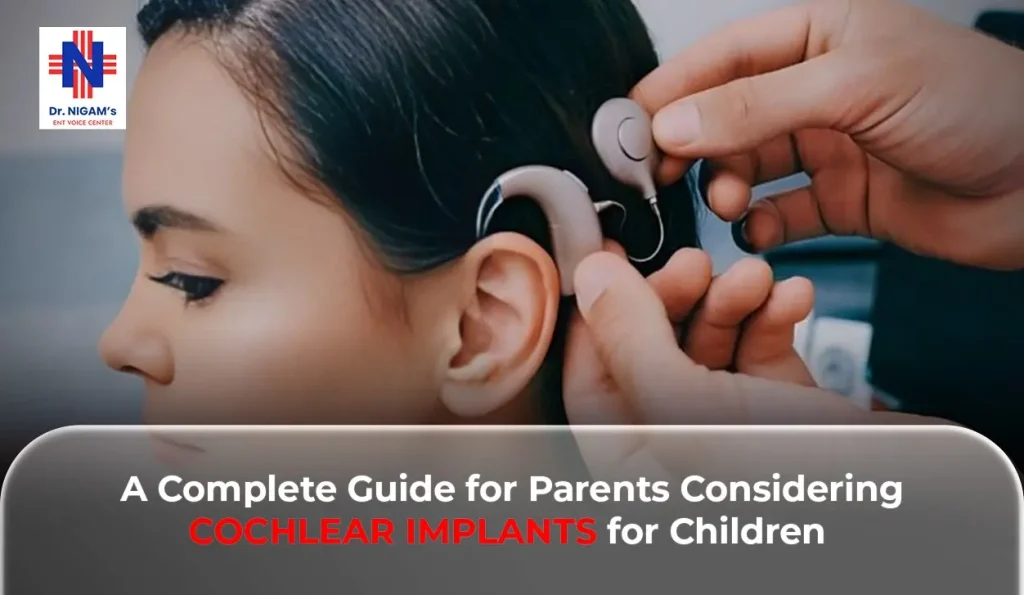
When a child is diagnosed with severe hearing loss, the first thing parents want to know is how they can help their child hear and talk better. Cochlear implants for children are one of the most advanced and effective treatments available today. They can help children hear and improve their speech development.
This guide gives you clear, research-based, and parent-centred information to help you make smart choices.
What are cochlear implants for kids? (Short answer first)
Cochlear implants for kids are electronic medical devices that go around damaged parts of the inner ear and directly stimulate the auditory nerve. This lets kids with severe hearing loss hear sounds.
Cochlear implants send electrical signals to the brain instead of amplifying sound like hearing aids do.
How Do Cochlear Implants Work?
There are two main parts to a cochlear implant:
- External Processor: Takes in sound and turns it into digital signals
- Internal Implant: A device that is surgically placed inside the body and stimulates the auditory nerve.
Working Mechanism (Simplified)
| Step | Process |
| 1 | Microphone captures sound |
| 2 | Speech processor converts sound into signals |
| 3 | Transmitter sends signals to implant |
| 4 | Implant stimulates auditory nerve |
| 5 | Brain interprets signals as sound |
Clinical data indicates that more than 90% of children with implants exhibit enhanced speech perception within the initial year of usage when accompanied by therapy.
Who Is a Suitable Candidate for Cochlear Implants?
Kids with severe to profound sensorineural hearing loss who don’t get much help from hearing aids.
Requirements for Eligibility
- Severe hearing loss in both ears
- Limited ability to understand speech
- Auditory nerve that is healthy
- Age: 9 to 12 months is the best time to start (for best results).
The World Health Organisation (WHO) has published research that shows that early intervention greatly helps with language learning and cognitive growth.
What Age Is Best for Cochlear Implant Surgery?
The sooner, the better—ideally before the child turns 2.
Why it matters to implant early
- Speech development that happens faster
- Improved neuroplasticity (brain adaptation)
- Better results in school and in social situations
A study in The Lancet showed that kids who got cochlear implants before they were 18 months old learned to talk as well as kids their age who could hear normally by the time they were 5.
What Happens During the Cochlear Implant Process?
A safe surgery that lasts 2 to 3 hours and is done under general anaesthesia.
A Step-by-Step Guide
- A small cut behind the ear
- Putting an implant under the skin
- Putting an electrode into the cochlea
- Device testing and closure
Most kids go home within 24 to 48 hours.
Is it safe for kids to have cochlear implant surgery?
Yes, it is a common and safe procedure.
Risk Factors (Not many, but important)
- Infection (not common)
- The device is broken
- Dizziness that doesn’t last long
Worldwide data shows that the success rate is over 95%, and complications happen in less than 2–3% of cases.
What Results Can Parents Expect After Getting Cochlear Implants?
Improved hearing, speech development, and communication skills over time.
Post-Implant Progress Timeline
| Time After Activation | Expected Outcome |
| 1–3 months | Awareness of sounds |
| 3–6 months | Recognition of voices |
| 6–12 months | Speech imitation |
| 1–2 years | Clear speech development |
Results depend a lot on regular therapy and parents being involved.
Why Is Speech Therapy Important After Implant?
The implant provides sound, but the brain must learn to interpret it.
Key Therapy Benefits
- Language development
- Listening skills
- Clear speech
- Social communication
Experts recommend regular auditory-verbal therapy (AVT) sessions for optimal results.
How much do cochlear implants cost in India?
It usually costs between ₹6 lakh and ₹12 lakh, depending on the hospital and the device.
Costs Explained
- Device cost: ₹5–8 lakh
- Cost of surgery: ₹1–2 lakh
- Therapy is still going on.
Sometimes, the government and NGOs offer programmes that help people with money.
What Are the Benefits of Cochlear Implants for Children?
- Better ability to hear speech
- Better language development
- More self-assurance and socialising
- Incorporation into conventional education
Studies show that children with implants are more likely to attend regular schools and achieve better academic outcomes.
Are there any restrictions that parents should be aware of?
Yes, it’s important to have realistic expectations.
Possible Limits
- Requires lifelong device care
- Needs therapy all the time
- Results differ among children.
- Not the same as hearing naturally
But with the right help, most kids make amazing progress.
How to Find the Best Cochlear Implant Specialist
Look for proven results, experience, and support from people in many fields.
Checklist for Choosing
- ENT surgeon with a lot of experience
- Help from a paediatric audiologist
- Availability of speech therapy
- System for care after surgery
Dr. Kunal Nigam is a specialist who focuses on patient-centred evaluation and long-term rehabilitation planning to help kids get better.
Questions that are often asked (FAQs)
1. After getting a cochlear implant, can my child hear normally?
No, but with therapy, they can learn to hear and speak almost normally.
2. Can you see the implant?
The internal device is hidden; only the external processor can be seen.
3. Is it possible to implant both ears?
Yes, bilateral implantation is often suggested to help with sound localisation.
4. Will my child need to be cared for for the rest of their life?
Yes, you need to get regular check-ups and upgrades every now and then.
5. Does the surgery hurt?
Very little pain; kids get better quickly, usually in a few days.
6. Is it okay for my child to go to a regular school?
Yes, a lot of kids do well in regular schools.
Conclusion: Choosing the Best Option for Your Child
Choosing cochlear implants for kids can change their lives by giving them the ability to hear, speak, and connect with others. Children can reach amazing developmental milestones with early help, professional care, and regular therapy.
Talk to an experienced professional, like Dr Kunal Nigam, if you’re considering this step. They can give you a thorough evaluation and a treatment plan that is right for you. The best way to change your child’s future is to do something at the right time.
Read More: How Cochlear Implant Surgery Works