Dr. Kunal nigams

📍125, First Floor, Splendor Trade Tower, Golf Course Extension Road, Sector 65, Gurugram || 📞 Contact: +91-880-0895-994

admin

A Complete Guide for Parents Considering Cochlear Implants for Children

A Complete Guide for Parents Considering Cochlear Implants for Children

When a child is diagnosed with severe hearing loss, the first thing parents want to know is how they can help their child hear and talk better. Cochlear implants for children are one of the most advanced and effective treatments available today. They can help children hear and improve their speech development. This guide gives you clear, research-based, and parent-centred information to help you make smart choices. What are cochlear implants for kids? (Short answer first) Cochlear implants for kids are electronic medical devices that go around damaged parts of the inner ear and directly stimulate the auditory nerve. This lets kids with severe hearing loss hear sounds. Cochlear implants send electrical signals to the brain instead of amplifying sound like hearing aids do. How Do Cochlear Implants Work? There are two main parts to a cochlear implant: Working Mechanism (Simplified) Step Process 1 Microphone captures sound 2 Speech processor converts sound into signals 3 Transmitter sends signals to implant 4 Implant stimulates auditory nerve 5 Brain interprets signals as sound Clinical data indicates that more than 90% of children with implants exhibit enhanced speech perception within the initial year of usage when accompanied by therapy. Who Is a Suitable Candidate for Cochlear Implants?  Kids with severe to profound sensorineural hearing loss who don’t get much help from hearing aids. Requirements for Eligibility The World Health Organisation (WHO) has published research that shows that early intervention greatly helps with language learning and cognitive growth. What Age Is Best for Cochlear Implant Surgery? The sooner, the better—ideally before the child turns 2. Why it matters to implant early A study in The Lancet showed that kids who got cochlear implants before they were 18 months old learned to talk as well as kids their age who could hear normally by the time they were 5. What Happens During the Cochlear Implant Process? A safe surgery that lasts 2 to 3 hours and is done under general anaesthesia. A Step-by-Step Guide Most kids go home within 24 to 48 hours. Is it safe for kids to have cochlear implant surgery? Yes, it is a common and safe procedure. Risk Factors (Not many, but important) Worldwide data shows that the success rate is over 95%, and complications happen in less than 2–3% of cases. What Results Can Parents Expect After Getting Cochlear Implants? Improved hearing, speech development, and communication skills over time.  Post-Implant Progress Timeline Time After Activation Expected Outcome 1–3 months Awareness of sounds 3–6 months Recognition of voices 6–12 months Speech imitation 1–2 years Clear speech development Results depend a lot on regular therapy and parents being involved. Why Is Speech Therapy Important After Implant?  The implant provides sound, but the brain must learn to interpret it.  Key Therapy Benefits  Experts recommend regular auditory-verbal therapy (AVT) sessions for optimal results.  How much do cochlear implants cost in India? It usually costs between ₹6 lakh and ₹12 lakh, depending on the hospital and the device. Costs Explained Sometimes, the government and NGOs offer programmes that help people with money. What Are the Benefits of Cochlear Implants for Children?  Studies show that children with implants are more likely to attend regular schools and achieve better academic outcomes.  Are there any restrictions that parents should be aware of? Yes, it’s important to have realistic expectations. Possible Limits But with the right help, most kids make amazing progress. How to Find the Best Cochlear Implant Specialist Look for proven results, experience, and support from people in many fields. Checklist for Choosing Dr. Kunal Nigam is a specialist who focuses on patient-centred evaluation and long-term rehabilitation planning to help kids get better. Questions that are often asked (FAQs) 1. After getting a cochlear implant, can my child hear normally? No, but with therapy, they can learn to hear and speak almost normally. 2. Can you see the implant? The internal device is hidden; only the external processor can be seen. 3. Is it possible to implant both ears? Yes, bilateral implantation is often suggested to help with sound localisation. 4. Will my child need to be cared for for the rest of their life? Yes, you need to get regular check-ups and upgrades every now and then. 5. Does the surgery hurt? Very little pain; kids get better quickly, usually in a few days. 6. Is it okay for my child to go to a regular school? Yes, a lot of kids do well in regular schools. Conclusion: Choosing the Best Option for Your Child Choosing cochlear implants for kids can change their lives by giving them the ability to hear, speak, and connect with others. Children can reach amazing developmental milestones with early help, professional care, and regular therapy. Talk to an experienced professional, like Dr Kunal Nigam, if you’re considering this step. They can give you a thorough evaluation and a treatment plan that is right for you. The best way to change your child’s future is to do something at the right time. Read More: How Cochlear Implant Surgery Works

A Complete Guide for Parents Considering Cochlear Implants for Children Read More »
How Cochlear Implant Surgery Works: Step-by-Step Guide

How Cochlear Implant Surgery Works: Step-by-Step Guide

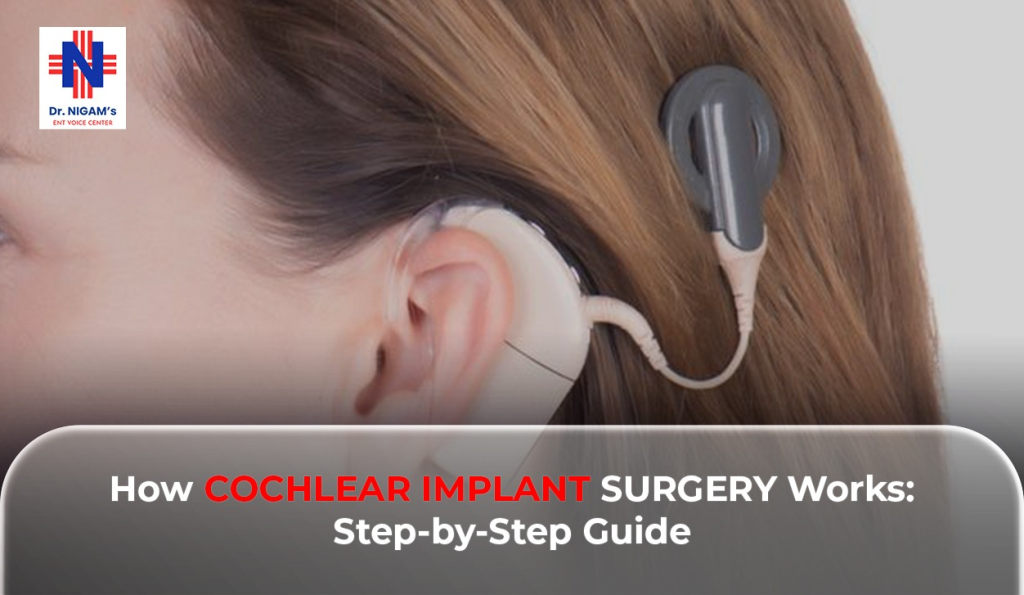
Cochlear implant surgery helps people with severe to profound hearing loss hear sounds by going around damaged parts of the inner ear and directly stimulating the auditory nerve. The surgery involves putting a small electronic device inside the ear and an external sound processor behind the ear. The whole thing is safe, organised, and usually done in a few hours with a high success rate. Based on clinical research and modern ENT surgical practice, this guide goes over the step-by-step process, recovery, benefits, risks, and real medical insights. What is cochlear implant surgery, and who needs it? It is best for people who can’t use hearing aids because their inner ear is too damaged. A cochlear implant is a high-tech hearing aid for people with sensorineural hearing loss, which means that the inner ear can’t send sound signals to the brain correctly. Some common candidates are the following: Medical studies from hearing institutes around the world show that more than 90% of patients who are carefully chosen see an improvement in their speech understanding after implantation. After a thorough hearing test, imaging, and speech test, experienced ENT doctors like Dr Kunal Nigam often recommend the procedure. How Does a Cochlear Implant Work Inside the Ear? The implant converts sound into electrical signals and sends them directly to the hearing nerve. A cochlear implant has two main parts: Component Function External Processor Captures sound and converts into digital signals Internal Implant Sends signals to the auditory nerve Electrode Array Placed inside cochlea to stimulate nerve Receiver Placed under the skin behind ear Unlike hearing aids, which only amplify sound, cochlear implants bypass the damaged cochlea and directly stimulate the nerve responsible for hearing. This is why they are useful in hearing loss cases where hearing aids fail. What Tests Are Done Before Cochlear Implant Surgery? Tests of hearing, CT scans, MRIs, and speech are all needed. Before surgery, doctors do a full check-up to make sure everything is safe and will go well. The following are part of the pre-surgery evaluation: Data from research shows that doing a good pre-operative evaluation increases the chances of an implant working by more than 30%. How to Do Cochlear Implant Surgery Step by Step? The surgery lasts two to three hours and is done while the person is asleep. Step 1: Get the anaesthesia The patient is put to sleep with general anaesthesia so they don’t feel any pain. Step 2: Make a small cut behind the ear. To get to the bone, a small cut is made behind the ear. Step 3: Opening the mastoid bone Using microsurgical tools, the surgeon makes a way to the inner ear. Step 4: Putting the electrode into the cochlea Carefully put a thin electrode inside the cochlea. Step 5: Fixing the receiver The implant receiver goes under the skin behind the ear. Step 6: Closing the cut The cut is sewn up and bandaged. Step 7: Turn on after healing After 2 to 4 weeks, the external processor is attached. Clinical ENT data shows: Factor Average Value Surgery time 2–3 hours Hospital stay 1 day Recovery time 1–2 weeks Activation time 3–4 weeks Time to activate: 3–4 weeks. Is cochlear implant surgery safe? Yes, it is an ENT surgery that is safe and common. International hearing research shows the success rate: Study Source Success Rate NIH Hearing Research 85–90% speech improvement WHO hearing program High safety profile ENT surgical registry Low complication rate Possible risks (not very often): The risk of complications is very low when the surgeons are experienced. What Happens After the Operation? (Recovery and Activation) Hearing doesn’t start right away; the device turns on after healing. Stages of recovery: Speech therapy is very important, especially for kids. Research indicates: How well does cochlear implant surgery work for kids and adults? Very effective when done at the right time. Research findings: Age Group Outcome Children under 5 Excellent speech development Children above 7 Good improvement Adults with recent hearing loss Very good results Long-term deaf adults Moderate improvement Early diagnosis leads to better outcomes. How long does a cochlear implant work? The implant can last for a long time. Facts: Implants made today are meant to last a long time. Who Should Not Have Cochlear Implant Surgery? Not recommended if the auditory nerve is hurt. Not good for: Before surgery, a proper evaluation is needed. Conclusion One of the most advanced treatments for severe hearing loss is cochlear implant surgery. It lets patients hear sounds again by directly stimulating the auditory nerve. The surgery follows a strict step-by-step plan and includes thorough testing before the surgery, and for best results, the patient must start speech therapy and activation after the surgery. This surgery has changed the lives of thousands of people around the world thanks to new methods, high success rates, and implants that last a long time. The most important things that make hearing restoration successful are a thorough evaluation, experienced surgical care, and a structured rehabilitation programme. Read More: Why Choosing a Local Cochlear Implant Surgeon Matters Questions that are often asked 1. Is it painful to have cochlear implant surgery? No. Surgery is done with anaesthesia, and the pain afterwards is not too bad. 2. How long does the surgery for a cochlear implant take? Most of the time, it takes 2 to 3 hours. 3. Is it possible for kids to have cochlear implant surgery? Yes, and surgery done early gives better speech results. 4. When will I hear from you after surgery? Hearing begins after activation, typically within 3 to 4 weeks. 5. Is a cochlear implant better than a hearing aid? Yes, for people with severe hearing loss who can’t use hearing aids. 6. Is it safe for adults to have cochlear implant surgery? Yes, it is safe for both kids and adults if an experienced ENT surgeon does it.

How Cochlear Implant Surgery Works: Step-by-Step Guide Read More »

Why Choosing a Local Cochlear Implant Surgeon Matters

Why Choosing a Local Cochlear Implant Surgeon Matters

Getting a cochlear implant can change your life when it comes to restoring your hearing. The treatment will only work if the surgeon has the right tools and is easy to get to. If you want to have good hearing outcomes, it’s best to choose a local Cochlear Implant Surgeon in Gurgaon. This will make it easier for you to talk to them, get follow-up care faster, and get long-term care. We are a trusted ENT doctor in Gurgaon, and we know that patients and their families want a specialist who is close by, trustworthy, and always available. In this article, we talk about why choosing a local specialist is so important and how the right ENT specialist in Gurgaon can make both surgery and recovery better. Why is it important to pick a cochlear implant surgeon who lives nearby? A cochlear implant procedure needs careful planning, surgery, activation, and follow-up care for a long time. When the surgeon is close by, it’s easier to handle each step. After surgery, a local cochlear implant surgeon in Gurgaon can keep an eye on things regularly, which is important for the device to work properly. Hearing implants need to be changed from time to time, and you may need to go to the doctor a lot in the first year. Going to appointments that are far away can be stressful, especially for kids and older people. We also make sure that patients always see the same ENT surgeon in Gurgaon. This helps keep treatment consistent and gives the surgeon a better understanding of the patient’s medical history. How does having an ENT doctor nearby help you recover after cochlear implant surgery? The recovery process after cochlear implant surgery doesn’t stop in the operating room. It includes taking care of wounds, turning on devices, mapping sessions, and help with speech therapy. Patients can easily go to follow-up visits on time when they choose a Cochlear Implant Doctor Near Me. Early follow-ups can find any infection, swelling, or problem with the device before it gets worse. We also work with audiologists and speech therapists to set up rehabilitation sessions. This makes sure that the patient gets full care from an experienced ENT doctor in Gurgaon. This combined method helps people get used to sound faster and hear better. Why is experience important in cochlear implant surgery? Cochlear implant surgery is a very specialized procedure that needs a lot of experience and knowledge about how the ear works. An experienced cochlear implant doctor can deal with difficult cases like congenital hearing loss, long-term deafness, and revision surgeries. We care about accuracy, safety, and making hearing better over time. Dr. Kunal Nigam and other specialists are known for doing delicate ear surgeries with great care, making sure that the implant is placed correctly for the best sound transmission. Patients should always look for a qualified ENT specialist in Gurgaon who does cochlear implant surgeries on a regular basis and knows the latest surgical methods. What tests do you need to take before cochlear implant surgery? A thorough evaluation is needed before the procedure can be done. A skilled ENT doctor in Gurgaon does a number of tests to make sure the patient is a good candidate for implantation. These tests usually have: A qualified cochlear implant surgeon in Gurgaon carefully reads these reports to plan the safest and most effective surgery. Why Is Local Follow-Up Care Essential After Cochlear Implant?  After surgery, cochlear implants need to be adjusted all the time. This treatment is different from other surgeries because it includes long-term hearing programming. Choosing a Cochlear Implant Doctor Near Me makes it easy to go back for follow-up visits. Several mapping sessions are held to change the device based on how well it works for hearing. Patients get timely care from an experienced ENT surgeon in Gurgaon, which helps them understand speech better and hear sounds more clearly. Can a surgeon in your area help you hear better in the long term? Yes, one of the best things about choosing a local Cochlear Implant Surgeon is that they will be there for you for a long time. Hearing implants need to be checked on a regular basis for years to keep working well. An ENT specialist in Gurgaon can help with: We make sure that every patient stays in touch with their surgeon so that they can keep getting better. Why Do Patients Prefer an ENT Specialist in Gurgaon for Advanced Ear Surgery?  Patients like having a specialist close by because it makes them feel safe and at ease. Patients feel better about the treatment when they can easily reach the surgeon. An ENT specialist in Gurgaon can quickly respond to emergencies, give immediate advice, and help the patient through every step of their recovery. This is very important for kids who need to be watched closely after getting cochlear implants. With the right care from a skilled ENT doctor in Gurgaon, recovery goes more smoothly and safely. Does a cochlear implant need speech therapy and rehabilitation? Yes, surgery alone won’t work. Rehabilitation is a big part of getting a cochlear implant. Patients have to learn how to understand sounds again after getting their implants. An experienced cochlear implant doctor works with audiologists and speech therapists to help patients get used to their new way of hearing. Regular sessions make things better: Patients get full support from surgery to full recovery with the help of experts like Dr. Kunal Nigam. Why Picking the Best Voice Surgeon in Gurgaon Is Also Good for ENT Patients There are often links between problems with the ears, nose, and throat. A lot of people who need ear surgery also have problems with their voice or throat. A qualified Best Voice Surgeon in Gurgaon or Voice Surgeon can help with ear problems, throat infections, vocal cord problems, and speech problems. A skilled ENT surgeon in Gurgaon can give patients all the care they need in one place, which leads

Why Choosing a Local Cochlear Implant Surgeon Matters Read More »