
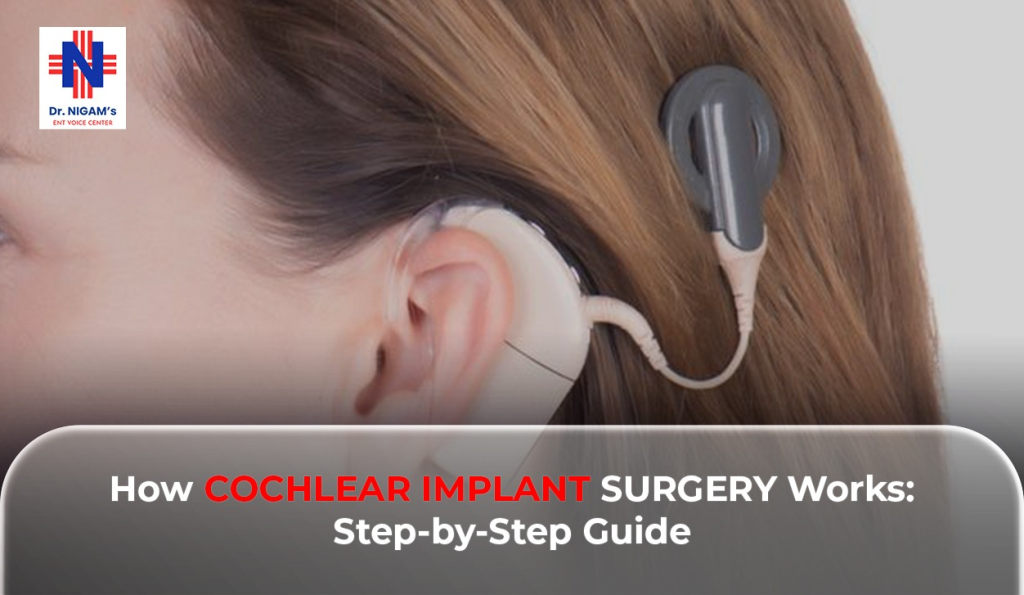
Cochlear implant surgery helps people with severe to profound hearing loss hear sounds by going around damaged parts of the inner ear and directly stimulating the auditory nerve. The surgery involves putting a small electronic device inside the ear and an external sound processor behind the ear. The whole thing is safe, organised, and usually done in a few hours with a high success rate.
Based on clinical research and modern ENT surgical practice, this guide goes over the step-by-step process, recovery, benefits, risks, and real medical insights.
What is cochlear implant surgery, and who needs it?
It is best for people who can’t use hearing aids because their inner ear is too damaged.
A cochlear implant is a high-tech hearing aid for people with sensorineural hearing loss, which means that the inner ear can’t send sound signals to the brain correctly.
Some common candidates are the following:
- Adults who have a lot of trouble hearing
- Kids who are born with hearing problems
- People who don’t respond to hearing aids
- People whose cochlea is broken but their auditory nerve is still working
Medical studies from hearing institutes around the world show that more than 90% of patients who are carefully chosen see an improvement in their speech understanding after implantation.
After a thorough hearing test, imaging, and speech test, experienced ENT doctors like Dr Kunal Nigam often recommend the procedure.
How Does a Cochlear Implant Work Inside the Ear?
The implant converts sound into electrical signals and sends them directly to the hearing nerve.
A cochlear implant has two main parts:
| Component | Function |
| External Processor | Captures sound and converts into digital signals |
| Internal Implant | Sends signals to the auditory nerve |
| Electrode Array | Placed inside cochlea to stimulate nerve |
| Receiver | Placed under the skin behind ear |
Unlike hearing aids, which only amplify sound, cochlear implants bypass the damaged cochlea and directly stimulate the nerve responsible for hearing.
This is why they are useful in hearing loss cases where hearing aids fail.
What Tests Are Done Before Cochlear Implant Surgery?
Tests of hearing, CT scans, MRIs, and speech are all needed. Before surgery, doctors do a full check-up to make sure everything is safe and will go well.
The following are part of the pre-surgery evaluation:
- Audiometry with pure tones
- Test for recognising speech
- CT scan of the temporal bone
- MRI of the inner ear
- Testing for balance
- Developmental assessment for kids
Data from research shows that doing a good pre-operative evaluation increases the chances of an implant working by more than 30%.
How to Do Cochlear Implant Surgery Step by Step?
The surgery lasts two to three hours and is done while the person is asleep.
Step 1: Get the anaesthesia
The patient is put to sleep with general anaesthesia so they don’t feel any pain.
Step 2: Make a small cut behind the ear.
To get to the bone, a small cut is made behind the ear.
Step 3: Opening the mastoid bone
Using microsurgical tools, the surgeon makes a way to the inner ear.
Step 4: Putting the electrode into the cochlea
Carefully put a thin electrode inside the cochlea.
Step 5: Fixing the receiver
The implant receiver goes under the skin behind the ear.
Step 6: Closing the cut
The cut is sewn up and bandaged.
Step 7: Turn on after healing
After 2 to 4 weeks, the external processor is attached.
Clinical ENT data shows:
| Factor | Average Value |
| Surgery time | 2–3 hours |
| Hospital stay | 1 day |
| Recovery time | 1–2 weeks |
| Activation time | 3–4 weeks |
Time to activate: 3–4 weeks. Is cochlear implant surgery safe?
Yes, it is an ENT surgery that is safe and common.
International hearing research shows the success rate:
| Study Source | Success Rate |
| NIH Hearing Research | 85–90% speech improvement |
| WHO hearing program | High safety profile |
| ENT surgical registry | Low complication rate |
Possible risks (not very often):
- Infection
- Dizziness
- Change in taste for a short time
- Failure of the device (rare)
The risk of complications is very low when the surgeons are experienced.
What Happens After the Operation? (Recovery and Activation)
Hearing doesn’t start right away; the device turns on after healing.
Stages of recovery:
- First week: healing the wound
- After 2 to 4 weeks, the device will be ready to use.
- After you turn it on, sound training begins.
- 3 to 6 months: speech gets better
- 1 year—full adaptation
Speech therapy is very important, especially for kids.
Research indicates:
- Children who get implants before age 5 learn to talk better.
- Adults gradually get better at speaking clearly.
How well does cochlear implant surgery work for kids and adults?
Very effective when done at the right time.
Research findings:
| Age Group | Outcome |
| Children under 5 | Excellent speech development |
| Children above 7 | Good improvement |
| Adults with recent hearing loss | Very good results |
| Long-term deaf adults | Moderate improvement |
Early diagnosis leads to better outcomes.
How long does a cochlear implant work?
The implant can last for a long time.
Facts:
- Implants that go inside the body can last more than 20 years.
- You might need to upgrade your external processor every few years.
- Regularly changing the battery
Implants made today are meant to last a long time.
Who Should Not Have Cochlear Implant Surgery?
Not recommended if the auditory nerve is hurt.
Not good for:
- No auditory nerve
- Infection in the ear that is active
- Medical conditions that make anaesthesia impossible
- Expectations that are not realistic
Before surgery, a proper evaluation is needed.
Conclusion
One of the most advanced treatments for severe hearing loss is cochlear implant surgery. It lets patients hear sounds again by directly stimulating the auditory nerve. The surgery follows a strict step-by-step plan and includes thorough testing before the surgery, and for best results, the patient must start speech therapy and activation after the surgery. This surgery has changed the lives of thousands of people around the world thanks to new methods, high success rates, and implants that last a long time. The most important things that make hearing restoration successful are a thorough evaluation, experienced surgical care, and a structured rehabilitation programme.
Read More: Why Choosing a Local Cochlear Implant Surgeon Matters
Questions that are often asked
1. Is it painful to have cochlear implant surgery?
No. Surgery is done with anaesthesia, and the pain afterwards is not too bad.
2. How long does the surgery for a cochlear implant take?
Most of the time, it takes 2 to 3 hours.
3. Is it possible for kids to have cochlear implant surgery?
Yes, and surgery done early gives better speech results.
4. When will I hear from you after surgery?
Hearing begins after activation, typically within 3 to 4 weeks.
5. Is a cochlear implant better than a hearing aid?
Yes, for people with severe hearing loss who can’t use hearing aids.
6. Is it safe for adults to have cochlear implant surgery?
Yes, it is safe for both kids and adults if an experienced ENT surgeon does it.